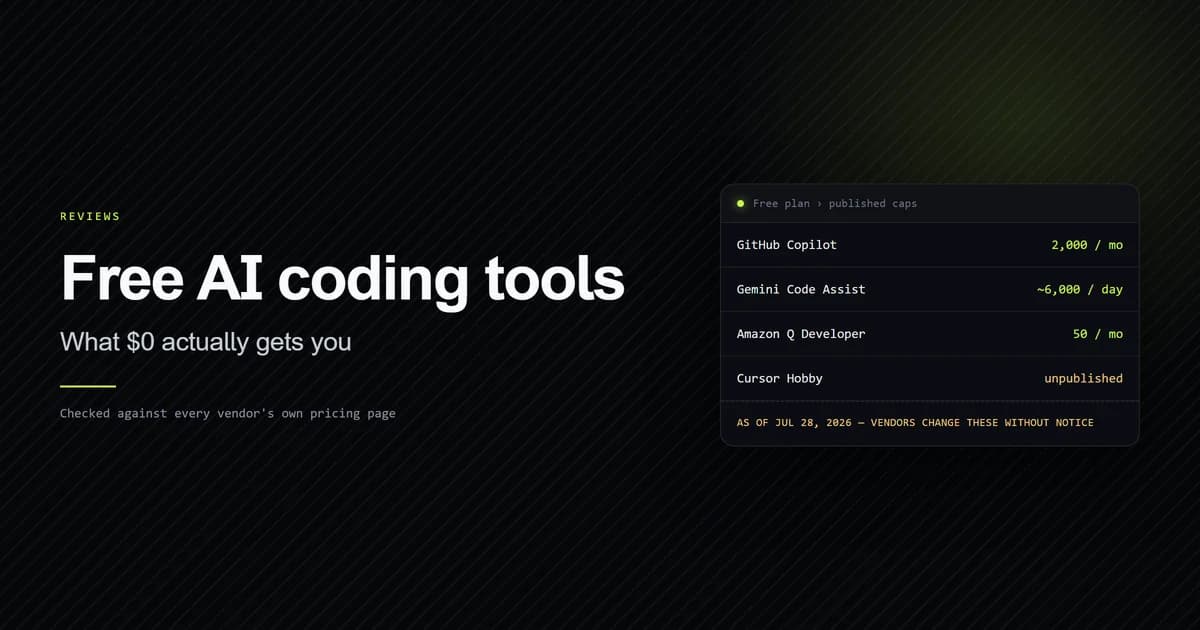
GitHub Copilot's free plan caps you at 2,000 completions and 50 chat requests a month, with no premium-model credits included. Cursor no longer publishes a number for its free Hobby tier at all — its pricing page just says "Limited." Gemini Code Assist gives away far more: Google's own quota documentation, checked July 28, 2026, lists roughly 6,000 code-completion requests and 960 chat requests per day for individual accounts. This guide checked the free ai coding tools worth considering against each vendor's current pricing or docs page, not a listicle repeating numbers a company quietly stopped publishing months ago.
Key takeaways
- GitHub Copilot's free plan is capped at 2,000 completions and 50 chat requests per month, with no access to the premium-model credit allowance paid tiers get.
- Cursor stopped publishing a numeric quota for its free Hobby tier; its pricing page now reads "Limited Agent requests" with no monthly cap stated anywhere.
- Gemini Code Assist's free individual tier has the most generous published numbers among major tools — about 6,000 completion requests and 960 chat requests per day, per Google's own docs.
- Claude's free plan does not include Claude Code at all; Claude Code requires Pro ($20/month, or $17/month billed annually) or API billing.
- Codeium and Windsurf no longer exist as independently priced products — both pricing pages now redirect into Devin's, after Cognition's acquisition of the Windsurf team.
What free actually means in AI coding tools
"Free" covers three different trade-offs in this category, and vendors rarely say which one they're offering. It's either a hard capped allowance that resets on a schedule (Copilot, Amazon Q), an unpublished "limited" allowance the vendor can quietly tighten without notice (Cursor), or a genuinely generous tier subsidized to win developer mindshare while a company is still building market share (Gemini Code Assist). Reading a vendor's own current pricing page is the only way to tell which one you're getting — third-party roundups routinely carry numbers the vendor has already changed.
GitHub Copilot free tier limits
Copilot's free plan gives you 2,000 code completions and 50 chat requests per month, with no credit card required, according to GitHub's own plans page checked July 28, 2026. The free tier uses automatic model selection — you don't pick Claude Haiku 4.5 or GPT-5 mini yourself, GitHub's routing decides based on current capacity — and it excludes the monthly AI-credit allowance ($15 on Pro, $70 on Pro+, $200 on Max) that lets paid tiers burn through premium models beyond the base quota. Copilot's free tier works in VS Code, JetBrains IDEs, and Neovim, plus the Copilot CLI, which is broader IDE coverage than any other free plan checked here.
Cursor free plan limits
Cursor's Hobby tier no longer states a number. As of July 28, 2026, cursor.com/pricing lists "Limited Agent requests" and "Access to Composer" with no monthly completion or request count attached to either line. Older roundups still repeat "2,000 completions and 50 premium requests a month" — that wording used to be accurate, but it is not what Cursor's current pricing page says, and there is no way to confirm it still applies without testing your own account's usage dashboard.
Claude free plan and Claude Code access
Claude's free plan does not include Claude Code — Anthropic's own pricing page lists Claude Code as a Pro-and-above feature, alongside Claude Cowork, Claude Design, and Claude Science. Pro costs $20/month, or $17/month if you pay $200 upfront for the year. Neither the pricing page nor Anthropic's usage-limit support article publishes an exact free-plan message count; the support page only states that paid plans get "five-hour session and weekly usage limits" visible in Settings, with no equivalent numeric disclosure for Free. If you do get Claude Code through Pro, a lean project configuration matters more under a metered budget than it would on an unlimited API plan — see how to set up CLAUDE.md for the structure that keeps a project's context small instead of burning it on repeated scans.
Gemini Code Assist free tier
Gemini Code Assist has been free for individual developers since March 2026, and its published numbers are the highest of any tool in this comparison. Google's own quota documentation, checked July 28, 2026, lists 6,000 requests per day for code generation and completion and 960 requests per day for chat, visualization, and data-insight table scans. That documentation does not explicitly label these figures as free-tier-only versus the Standard or Enterprise editions, so treat the exact ceiling as directionally right rather than contractually guaranteed — but even a conservative reading puts it well above Copilot's 2,000-per-month cap.
Amazon Q Developer free tier
Amazon Q Developer's free tier includes 50 agentic requests per month and access to the latest Claude models inside the IDE or CLI, per AWS's own pricing page checked July 28, 2026. AWS does not break that number down into separate chat and completion quotas the way Copilot does — it's one combined "agentic requests" budget. The Pro tier costs $19 per user per month and adds expanded request limits, Java and .NET transformation tooling, an admin dashboard, and IP indemnity, which matters more to a team than a solo developer evaluating the free plan.
Windsurf and Codeium after the Devin acquisition
Windsurf and Codeium are no longer separately priced products. Fetching codeium.com/pricing on July 28, 2026 redirects to windsurf.com/pricing, which itself redirects to devin.ai/pricing — the result of Cognition's acquisition of the Windsurf team. Devin's free tier is listed at $0 with "light quota to code with agents" and unlimited inline edits and Tab completions, but like Cursor, no numeric monthly cap is published. If you're choosing based on an older Windsurf or Codeium comparison, confirm the product still exists under that name before relying on its numbers.
Free tier comparison table
| Tool | Free plan cap (as published) | What the free plan excludes | Cheapest paid step-up |
|---|---|---|---|
| GitHub Copilot | 2,000 completions + 50 chat/month | Premium-model credit allowance, manual model choice | Pro, $10/month |
| Cursor | No number published ("Limited") | Composer detail, model choice | Pro, $20/month |
| Claude | No number published; excludes Claude Code entirely | Claude Code, Opus/Fable-tier models | Pro, $20/month ($17/month annual) |
| Gemini Code Assist | ~6,000 completion + 960 chat requests/day | Full agent-mode ceiling of paid editions | Standard, $19/user/month |
| Amazon Q Developer | 50 agentic requests/month | Java/.NET transformation, admin dashboard | Pro, $19/user/month |
| Devin (Windsurf/Codeium) | Unlimited inline edits + Tab; agent quota "light," no number | Full agent quota | Priced per plan on devin.ai |
Which free tier to pick
If you want the highest published ceiling and don't mind Google's ecosystem, Gemini Code Assist's free tier currently gives the most room before you hit a wall. If IDE breadth matters more than raw quota, Copilot's free plan is the only one that states its numbers plainly and covers VS Code, JetBrains, Neovim, and a CLI. If you specifically want Claude Code, there is no free path to it — budget for Pro at minimum. Cursor and Devin's free tiers are the hardest to evaluate in advance because neither publishes a number, so budget a week of real use before deciding either is "enough."
The right pick also depends on what you're actually doing with it. Someone learning to code mostly needs volume and doesn't care which model answers — Gemini Code Assist's daily reset and higher published ceiling suit that better than Copilot's monthly one, because a bad week doesn't cost you the rest of the month. A working developer doing focused, professional edits in one IDE all day is better served by Copilot's free plan specifically because the numbers are public and stable enough to plan around — you know exactly when you'll hit the wall. Someone evaluating a tool for a team should ignore every free tier in this comparison and go straight to the vendor's team pricing, since free-tier behavior (especially Cursor's and Devin's undisclosed quotas) has no contractual bearing on what a paid seat gets.
Common mistakes with free tiers
- Trusting a specific number without a source link. Cursor's old 2,000/50 figures still circulate on comparison sites; the vendor removed them from its own pricing page. If an article states a number, check whether it links the vendor's current page.
- Assuming "free Claude" means "free Claude Code." They are different products on Anthropic's own plan tiers — the chat product is free, the CLI is not.
- Ignoring combined quotas. Amazon Q's "50 agentic requests" is one shared budget, not 50 chat plus 50 completions — read whether a vendor's cap is combined or split before you plan around it.
- Not tracking the reset window. Monthly caps (Copilot, Amazon Q) and daily caps (Gemini Code Assist) run out at very different rates for the same total workload.
- Comparing a free tier to a paid competitor's feature set. A free plan's job is to get you using the product, not to match what a $20/month competitor ships — judging Cursor's Hobby tier against Copilot Pro's feature list, for instance, compares the wrong two plans.
Conclusion
For raw published quota, Gemini Code Assist currently wins. For predictable behavior across editors, Copilot is the one plan that still states exact numbers. If Claude Code is the actual goal, skip the free-tier comparison entirely and budget for Pro. Re-check whichever plan you pick against its current pricing page before committing — every number in this piece carries today's date because none of them are guaranteed to hold past this quarter.
Frequently asked questions
Is GitHub Copilot actually free?
Does Claude's free plan include Claude Code?
What is the best free AI coding assistant in 2026?
What happened to Windsurf and Codeium's free plans?

Muhammad Kashif
Founder and editor of Devventa, covering AI coding assistants, Next.js and the modern AI development stack.