GitHub Copilot vs Claude Code is no longer autocomplete versus agent, and any comparison still built on that framing is describing February 2026 or earlier. Copilot CLI reached general availability on February 25, 2026 with plan mode, an autonomous autopilot mode, multi-model support, and cross-session repository memory — the same shape as Claude Code. The decision now turns on three things that have not converged: where the agent is allowed to run, how each vendor meters you, and which models each one can reach. Every figure below was checked against vendor documentation on August 1, 2026, against Claude Code 2.1.220.
Key takeaways
- Copilot CLI has been generally available since February 25, 2026, with plan mode bound to Shift+Tab, an autopilot mode, and multi-model selection — so "Copilot is just completions" is factually out of date.
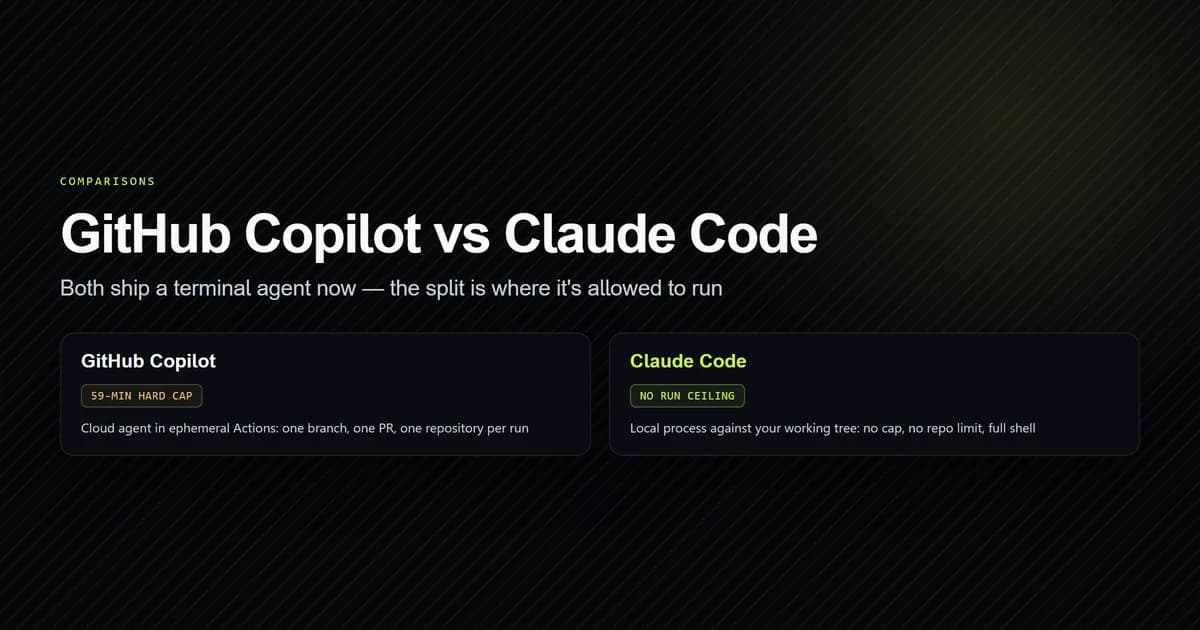
- Copilot's cloud agent runs in ephemeral GitHub Actions with a hard 59-minute cap, works on one branch, opens exactly one pull request, and cannot change more than one repository per run.
- Copilot bills token-metered AI credits on top of the seat price — Pro is $10/month with 1,500 credits at 1 credit = $0.01 — while code completions are unlimited and consume no credits on paid plans.
- Copilot can run Claude Opus 4.6 and Claude Sonnet 4.6 alongside GPT-5.3-Codex and Gemini 3 Pro; Claude Code runs Anthropic models only, which makes model choice a Copilot advantage.
- Copilot reads
CLAUDE.mdas an agent instruction file, so an existing Claude Code config transfers to Copilot — but not the reverse.
GitHub Copilot vs Claude Code at a glance
| Dimension | GitHub Copilot | Claude Code |
|---|---|---|
| Terminal agent | Copilot CLI, GA February 25, 2026 | claude, the original surface |
| Cloud agent | Ephemeral GitHub Actions, 59-min hard cap | None — runs on your machine |
| Repository scope | One repository per cloud-agent run | Whole working tree, plus --add-dir |
| Models | Claude Opus 4.6, Sonnet 4.6, GPT-5.3-Codex, Gemini 3 Pro | Anthropic models only |
| Entry price | $10/month (Pro) | $20/month (Pro, billed monthly) |
| Metering | Token-based AI credits, 1 credit = $0.01 | Subscription tiers with usage limits |
| Config file | AGENTS.md, .github/copilot-instructions.md, CLAUDE.md | CLAUDE.md |
Read that table as two products converging on features and diverging on constraints. If your work is issue-driven and lives on GitHub, Copilot's loop is shorter. If your work is a long refactor across more than one repository, Copilot's cloud agent structurally cannot do it in one run and Claude Code can. The same terminal-versus-editor logic that separates Claude Code from Cursor does not separate these two — both are terminal-first agents now.
What changed in February 2026
Copilot CLI went from public preview to general availability on February 25, 2026, and the
feature list in GitHub's own changelog is the reason the old comparison collapsed. Plan mode
is bound to Shift+Tab, where "Copilot analyzes your request, asks clarifying questions, and
builds a structured implementation plan before writing any code" — the same interaction
Claude Code exposes and that we cover in
Claude Code plan mode. Autopilot mode "lets
Copilot work autonomously—executing tools, running commands, and iterating without stopping
for approval." Prefixing a prompt with & delegates the work to the cloud agent. Repository
memory means "Copilot remembers conventions, patterns, and preferences it learns about your
codebase across sessions."
That is close enough to Claude Code's session model that feature-list comparisons between the two now expire in weeks. The constraints below do not.
Where the two agents actually run
This is the sharpest remaining difference, and it is a hard limit rather than a preference. Copilot's cloud agent "has access to its own ephemeral development environment, powered by GitHub Actions," and GitHub documents the boundaries plainly: maximum execution time is "59 minutes"—"a hard limit that cannot be extended"—it works "on one branch at a time," it "can open exactly one pull request," and "Copilot can only make changes in the repository specified when you start a task" and "cannot make changes across multiple repositories in one run."
Claude Code has none of those ceilings because it runs as a process on your machine against your working tree. A four-hour session is a four-hour session. A change spanning three checked-out repositories is a matter of granting directory access. The cost of that freedom is that the work stops when your laptop sleeps, and that you are the sandbox — which is exactly what Copilot's ephemeral Actions environment is designed to avoid.
Neither model is strictly better. A cloud agent that opens one clean pull request per issue is a better fit for a team with branch protection and a review queue. A local agent with a full shell is a better fit for exploratory work that does not know its own shape yet.
How each one bills you
The two are metered on different axes, which is why seat-price comparisons mislead. GitHub moved all Copilot plans to usage-based billing on June 1, 2026: each plan now includes a monthly allotment of GitHub AI Credits, where 1 AI credit equals $0.01 USD and consumption is calculated from input, output, and cached tokens at each model's listed API rates.
| Plan | Price | Included AI credits |
|---|---|---|
| Copilot Free | $0 | Allowance only; completions capped at 2,000/month |
| Copilot Pro | $10/month | 1,000 base + 500 flex = 1,500 |
| Copilot Pro+ | $39/month | 3,900 base + 3,100 flex = 7,000 |
| Copilot Max | $100/month | 10,000 base + 10,000 flex = 20,000 |
At $0.01 per credit, Pro's 1,500 credits are $15 of model usage, Pro+ is $70, and Max is $200. Code completions sit outside that meter entirely — unlimited on Pro, Pro+, and Max.
Anthropic prices differently: Claude Pro is $20/month billed monthly ($17/month on an annual plan), Max tiers start from $100/month, and every tier including Free lists Claude Code as included, with usage limits rather than a published per-token meter. So Copilot gives you a number to budget against and Claude gives you a tier to sit inside. For the full breakdown of how credits, multipliers, and overage interact across vendors, see what AI coding assistants actually cost.
Model choice is Copilot's real advantage
Copilot CLI ships multi-model support, and the GA announcement names the options: "Claude Opus 4.6, Claude Sonnet 4.6, GPT-5.3-Codex, and Gemini 3 Pro." Claude Code runs Anthropic models only. For anyone who wants to A/B a hard refactor across vendors, or who has a compliance reason to avoid one provider, that is a decisive Copilot win — and the honest reading is that Copilot is the more flexible product on this axis, not the less capable one.
It also splits a decision that used to be one choice. "Which model do I want" and "which harness do I want" are now independent, and Copilot CLI running Claude Opus 4.6 is a real configuration rather than a hypothetical. If your reason for choosing Claude Code was the model rather than the tool, that reason no longer requires the tool.
Config files and how portable they are
Copilot reads more instruction files than Claude Code does, and one of them is Claude Code's.
GitHub's response-customization documentation lists three types: repository-wide instructions
in .github/copilot-instructions.md, path-specific NAME.instructions.md files under
.github/instructions, and agent instruction files named AGENTS.md, CLAUDE.md, or
GEMINI.md. Precedence runs personal, then repository, then organization instructions, and
GitHub notes that agent instructions "are currently not supported by all Copilot features."
The practical consequence is asymmetric portability. This repository's CLAUDE.md is 135
lines of build traps and constraints — the dev-server-versus-build collision, the MDX
string-attribute rule, the D1 access choke point — and Copilot would read that file as-is.
Claude Code would not read a .github/copilot-instructions.md. So trialling Copilot on a
repository that already has a working
CLAUDE.md configuration costs nothing in setup, which
substantially lowers the barrier to treating Copilot as a copilot alternative in reverse —
evaluating it without dismantling anything.
Where Claude Code still wins
Beyond the missing execution ceilings, Claude Code's advantage is granularity of control over
a local machine. Permissions are per-command allowlist rules rather than a trust boundary you
accept once, and that is a real mechanism with a real failure mode. This repository's own
.claude/settings.local.json currently holds 93 allow entries — 60 Bash(...) rules, 19
WebFetch(domain:...) rules, and 8 PowerShell(...) rules:
node -e "const a=require('./.claude/settings.local.json').permissions.allow; console.log(a.length)"
# → 93
When we documented this same file for the plan mode article on July 27, 2026, it held 70 entries. Five days of work added 23 more. That growth rate is the honest cost of the model: fine-grained permission control produces a file that grows monotonically and never gets pruned.
And here is the part that did not work. Three of those 93 entries are still pinned to an absolute scratchpad path under a project directory this repository no longer occupies. They match nothing, they will never match anything again, and nothing warns you — the commands they were meant to pre-approve simply prompt for permission again as though the entries were never added. An allowlist is a cache with no invalidation, and it rots silently. Copilot's coarser-grained trust model cannot rot this way, because there is nothing per-command to go stale.
Claude Code also has the deeper extension surface. Skills, hooks, and subagents are documented
extension points with their own file formats, and Copilot's CLI has no direct equivalent to a
PreToolUse hook that can deterministically block a tool call before it runs.
Is Copilot worth it in 2026
Yes, for most developers whose work already lives on GitHub — and the honest answer to is Copilot worth it has changed within the last six months. At $10/month for unlimited completions, 1,500 AI credits, a GA terminal agent, and four selectable frontier models, Pro is the cheapest credible agentic setup on the market, half Claude Pro's $20 monthly rate. The issue-to-pull-request loop is genuinely shorter than anything you assemble by hand, because the agent is a first-party part of the platform the issue already lives in.
It is not worth it as your only tool if your work regularly exceeds what the cloud agent can express: one branch, one pull request, one repository, 59 minutes. Those are the cases where a local agent is not a preference but a requirement, and where Claude Code is the better primary tool with Copilot kept for the GitHub-shaped work.
Common mistakes when comparing them
- Comparing Copilot's completions to Claude Code's agent. Copilot has had a GA terminal agent with plan mode since February 25, 2026; comparing its 2024 autocomplete behaviour to Claude Code's agent is comparing different products.
- Assuming Claude Code has the model advantage. Copilot CLI selects across Anthropic, OpenAI, and Google models. Claude Code is Anthropic-only. On model choice, Copilot wins.
- Budgeting Copilot from request-based pricing. Premium requests and per-feature multipliers are legacy billing as of June 1, 2026 and now apply only to some annual subscribers.
- Comparing $10 to $20 as if they buy the same thing. Copilot's seat carries a token meter that can be exceeded; Claude's tiers carry usage limits instead. The floor is not the ceiling in either case.
- Treating an existing CLAUDE.md as a switching cost. Copilot reads
CLAUDE.mdas an agent instruction file, so the config transfers. The reverse does not. - Ignoring the 59-minute cap until it matters. It is documented as a hard limit that cannot be extended, and it is the constraint most likely to end a long agentic run without warning.
Conclusion
Pick Copilot Pro if your work is issue-driven, lives on GitHub, and fits inside one repository
per task — it is cheaper, it selects across four frontier models, and its completions are
unlimited. Pick Claude Code if you run long sessions, cross repository boundaries, or want
per-command permission control and hooks. Run both if your week contains both shapes of work;
Copilot reads your existing CLAUDE.md, so the trial costs configuration time you have
already spent. Re-check both vendors' pricing pages before committing — Copilot's billing
model changed twice in 2026 already. Start with the
complete Claude Code guide if the terminal agent is
new to you.
Frequently asked questions
Is Claude Code better than GitHub Copilot?
Is GitHub Copilot worth it in 2026?
Can GitHub Copilot use Claude models?
Does GitHub Copilot read CLAUDE.md?
What is the cheapest way to get an agentic coding CLI?

Muhammad Kashif
Founder and editor of Devventa, covering AI coding assistants, Next.js and the modern AI development stack.