GitHub Copilot's Pro plan costs $10/month with $15 of monthly credits — but a single automated code review burns 13 of those credits at once, per GitHub's own documentation checked July 29, 2026. Cursor's $20/month Pro plan includes "a set amount of model usage" with no published number, then bills overage in arrears. Claude Code is included from Claude Pro at $20/month, with Max tiers starting at $100/month for heavier usage. AI coding assistant pricing in 2026 isn't one number — it's a seat price plus a usage meter, and the meter is where the real cost lives.
Key takeaways
- GitHub Copilot Pro costs $10/month with $15 of included credits; overage premium requests cost $0.04 each, but a Copilot code review consumes 13 requests in one action.
- Cursor Pro is $20/month with an unpublished usage allowance; Pro+ and Ultra scale that allowance up without Cursor listing separate prices for either tier on its pricing page.
- Claude Code is a Pro-and-above feature, not free-tier — Pro is $20/month ($17/month billed annually), and Max plans start at $100/month for roughly 5x Pro's usage.
- Premium-request multipliers, not the base seat price, are where AI coding assistant pricing actually diverges between light chat use and heavy agentic workflows.
- None of the three vendors checked here publish a hard token cap on their cheapest paid tier — all three convert to usage-based billing once the included allowance runs out.
What pricing actually covers in 2026
A monthly seat price used to be the whole answer. It no longer is. Every major AI coding assistant now layers a usage meter under the flat fee: GitHub Copilot calls it credits and premium requests, Cursor calls it "included model usage" with on-demand billing after, and Claude Code ties usage to session and weekly limits that scale with plan tier. Comparing AI coding assistant pricing by seat price alone misses the number that actually determines your bill in month two.
The shift happened because flat-fee AI usage doesn't scale with vendor cost — a developer running an agentic session that reads forty files and edits ten costs a vendor far more than one who asks for a single autocomplete. Credits and multipliers are how that cost gets passed back to the user without changing the advertised sticker price.
GitHub Copilot credits and request multipliers
Copilot Pro costs $10/month per user and includes $15 of monthly credits, per GitHub's plans page checked July 29, 2026. Pro+ costs $39/month with $70 of credits, and a Max tier at $100/month carries $200 of credits — each tier scaling credits faster than price, which rewards heavier users who upgrade rather than pay per-request overage.
The part that catches people is the multiplier. GitHub's premium-requests documentation states plainly that "the number of premium requests a feature consumes can vary depending on the feature and the AI model used." A single chat prompt is one request. A Copilot code review is 13 requests. Spark is a flat 4 requests per prompt. At $0.04 per request once credits run out, three automated code reviews a day — a realistic CI habit, not an edge case — consumes 39 requests daily, or roughly $1.56/day in overage once the included $15 runs dry, well before the billing cycle resets.
Cursor usage-based pricing
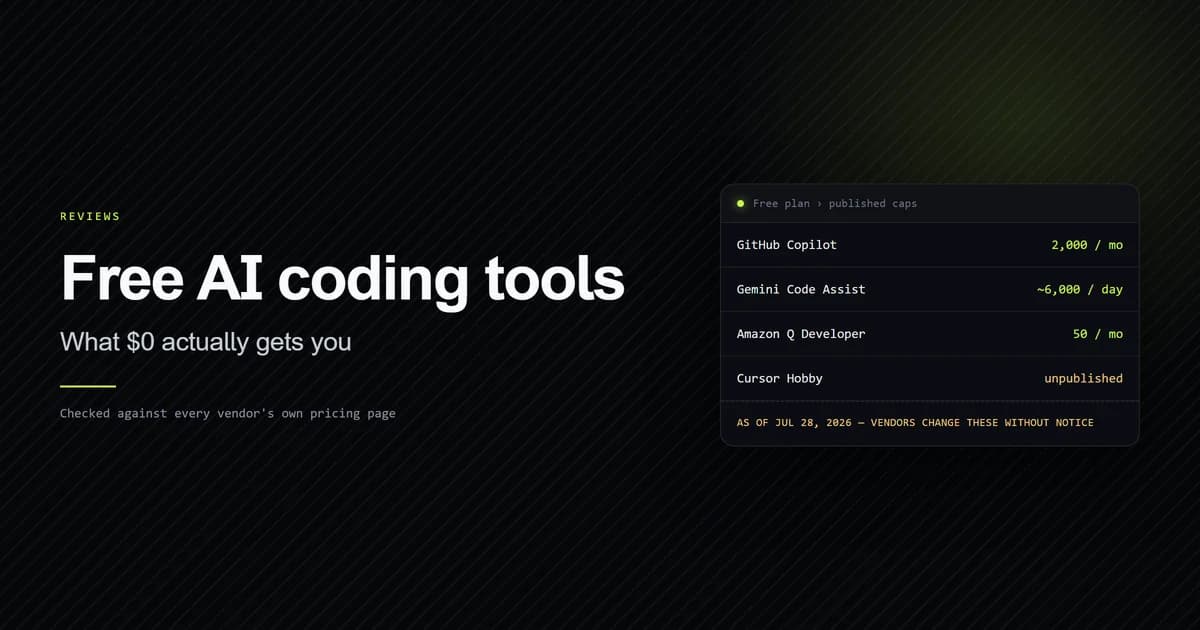
Cursor's Hobby tier is free with, per cursor.com/pricing checked July 29, 2026, "Limited Agent requests" and no published number — consistent with what this site's free-tier comparison found in a separate check the same week. Cursor Pro costs $20/month and is the only individual tier with an exact list price stated on the page; Pro+ and Ultra are described only in relative terms — Pro+ as "3x Pro limits on Agent" and Ultra as "20x Pro limits on Agent" — without a second or third dollar figure printed anywhere on the same page.
Every paid Cursor plan includes, in the page's own words, "a set amount of model usage," and on-demand usage after that "allows you to continue using models after your included amount is consumed, billed in arrears." That's a genuinely different pricing shape than Copilot's pre-purchased credit block — Cursor doesn't cut you off, it keeps billing. Cursor pricing without a number attached to the included amount makes it the hardest of the three to budget in advance; the only reliable way to know your actual usage rate is your own account's usage dashboard, not a blog post's remembered figure.
Claude Code and the Max plan tiers
Claude Code is not a free-tier feature. It's included starting at Claude Pro, $20/month billed monthly or $17/month if you pay annually, per claude.com/pricing checked July 29, 2026 — the same finding this site's free-tier comparison reached checking the same page days earlier. For workflows heavier than Pro's usage allowance, Claude Max starts at $100/month for the 5x tier, described on the pricing page as "5x or 20x more usage than Pro." The 20x tier is grouped under the same "from $100" heading rather than listed as a separate number, so budgeting the exact cost of 20x usage requires checking your own account rather than relying on the marketing page.
Anthropic's support documentation adds a second axis most Copilot and Cursor plans don't publish at all: a five-hour session limit alongside a weekly limit, both visible in Settings once you're on a paid plan. That structure rewards steady, spread-out usage over one long marathon session — a distinction genuinely worth understanding if the goal is using Claude Code across a real project workflow rather than a single afternoon of heavy agentic work. For the mechanics of Claude Code itself — how sessions, context, and CLAUDE.md interact with a metered plan — see the complete Claude Code guide.
Pricing comparison table
| Tool | Cheapest paid tier | Included allowance | Overage model |
|---|---|---|---|
| GitHub Copilot | Pro, $10/month | $15 monthly credits | $0.04/request; up to 13x per feature |
| Cursor | Pro, $20/month | Unpublished usage amount | Billed in arrears, no cutoff |
| Claude Code (Claude) | Pro, $20/month ($17 annual) | 5-hour + weekly session limits | Upgrade to Max 5x/20x from $100/month |
The hidden costs a seat price does not show
The seat price answers "what do I pay to start." It doesn't answer what a realistic workload costs once you're past the included amount, and that's the number that actually determines whether a tool is affordable for your usage pattern. Three costs never make it onto a pricing page's headline number:
Feature multipliers compound with automation. Wiring an AI feature into a script or CI job multiplies its request cost by however many times it runs — Copilot's 13x code review multiplier turns "add automated review to every PR" into a materially different monthly bill than "review code manually in chat sometimes."
Unpublished quotas are a planning risk, not a savings. Cursor's and, on the free tier, Claude's lack of a stated number doesn't mean unlimited — it means the ceiling can move without notice, and the only way to find it is to hit it.
Team plans change who pays for what. Every vendor checked here prices teams per-seat with centralized billing, which shifts overage risk from an individual's card to a shared pool — worth confirming before assuming an individual plan's math scales linearly to a team of five.
Which pricing model fits your workflow
Pick Copilot if you want a hard, predictable credit ceiling and are willing to watch which features you automate — the $15/$70/$200 tiers are exact numbers you can budget against, as long as you know a code review costs 13x a chat prompt. Pick Cursor if editor-native agent work matters more than knowing the exact request cost in advance, and you're comfortable checking your usage dashboard rather than a fixed number. Pick Claude Code, starting at Pro, if the work is CLI-first and cross-repo — the five-hour and weekly limit structure suits steady daily use better than one long burst, and Max exists once that structure isn't enough.
Teams should stop comparing individual-plan numbers entirely once headcount is more than one or two people — per-seat team pricing changes the overage math for all three vendors, and none of the individual-plan figures in this piece translate directly to a team budget.
Common mistakes
- Comparing seat price alone. A $10 Copilot Pro plan and a $20 Cursor Pro plan aren't comparable on price alone — one ships a hard credit number, the other doesn't publish one at all. Compare the overage model, not just the sticker.
- Not checking a feature's request multiplier before automating it. Copilot's 13x code-review multiplier is easy to miss until a CI job burns a month's credits in a week.
- Trusting a specific Cursor Pro+/Ultra dollar figure from a blog post. Cursor's own pricing page states Pro's price plainly but doesn't list separate prices for Pro+ or Ultra — a specific number for either without a link to Cursor's current page is stale.
- Assuming Claude Max 5x and 20x cost the same because the page groups them. They don't — "from $100" describes a starting point, not a shared price; confirm the actual 20x cost in your own account before budgeting it.
- Budgeting an individual plan's numbers for a team. Team and Business tiers on all three vendors change the billing and overage structure — don't extrapolate.
Best practices
- Check the vendor's own pricing page before publishing or budgeting a number. Third-party roundups routinely repeat figures a vendor has already changed.
- Read the multiplier table before wiring a feature into automation. A feature that's cheap manually can be expensive scripted, as Copilot's code review multiplier shows.
- Track your actual usage for one billing cycle before upgrading a tier. Every vendor here provides a usage dashboard — use it instead of guessing from the marketing copy.
- Re-verify pricing quarterly. This category changes fast enough that a six-month-old number is a liability, not a convenience.
Conclusion
Copilot gives you the clearest number to budget against — $15, $70, or $200 in monthly credits, if you also track which features cost more than one request. Cursor and Claude's free tier trade that predictability for an unpublished ceiling you only find by using the product. If Claude Code specifically is the goal, budget for Pro at minimum and check whether Max's session structure actually fits before paying for 5x or 20x you might not use. Re-check every figure in this piece against the vendor's current pricing page before committing a budget to it — none of these numbers are contractually guaranteed to hold past this quarter.
Frequently asked questions
How much does GitHub Copilot actually cost with overage?
What does Cursor cost beyond the $20 Pro plan?
Is Claude Code included in Claude Pro or only Max?
What is a premium request in GitHub Copilot?
Why doesn't Cursor publish a specific pricing number for Pro+ and Ultra?

Muhammad Kashif
Founder and editor of Devventa, covering AI coding assistants, Next.js and the modern AI development stack.